Sunday, July 15, 2007

Porcupine Tree's Steven Wilson Waxes Melancholic On Blackfield II
Music Review: Blackfield - Blackfield II

About three months ago now, I made one of the most pleasantly unexpected musical discoveries I've made in several years. Porcupine Tree is a band I discovered more or less by accident when I wrote a couple of articles here about Marillion — another prog-rock band from England — and several readers urged me to check out PT in comments they left.

So check them out I did.

Actually dove in head first is more like it. After purchasing Porcupine Tree's newest CD Fear Of A Blank Planet, I was so knocked out I bought several more of their CDs. Three months in, and I am still constantly hearing something new that I missed every time I put on one of their CDs. Honestly, for a band that has been around for as long as Porcupine Tree has — they've been putting out records since about the early nineties now — I am absolutely amazed they are not more of a household name in this country.

But what I find most inexplicable is how a guy like Steven Wilson — PT's principal singer, songwriter, guitarist, and all around resident genius — hasn't received wider recognition, both critically and otherwise. Not only is Wilson a great guitar player and singer, he is also an extremely prolific and multi-faceted songwriter. On Porcupine Tree's records alone, Wilson goes from the Floydian atmospherics of early albums like The Sky Moves Sideways, to the beautifully crafted pop of something like Deadwing's "Lazarus," to the all out metallic shredding of Fear Of A Blank Planet's eighteen minute opus "Anesthetize."

On Blackfield II, Wilson's second collaboration with Israeli songwriter Aviv Geffen, Wilson reveals yet another side of his musical personality. I'm not sure exactly when or how I heard this was more of a quieter, acoustic sort of record than the heavier sounding stuff that Wilson does with Porcupine Tree. Because the truth is, it is anything but.

To be sure, Blackfield II is nowhere near as heavy as Porcupine Tree can be, but neither does it resemble anything that sounds stripped down in any way. The sound here is every bit as full as a Porcupine Tree record, but is lush with beautifully sweeping string arrangements and romantic sounding pop tunes, the same way that Porcupine Tree leans to the proggier side of metal. However where the sound is sweet, the lyrics are full of darkness and melancholy.


Steven Wilson sings the lead parts solo on six of this album's tracks, and produced the record. But before you think this may be just be a Wilson solo project, think again. Aviv wrote fully half of the songs here — many of which were translated from his original Hebrew. He also handles all of the string arrangements — which as I've already said, play a dominant role on the album. So Aviv is not just playing Andrew Ridgely to Wilson's George Micheal here.

But back to those dark lyrics. Much of the album seems to deal in themes of dark or outright doomed love. On "Epidemic," for example, the happy chorus goes something like " An epidemic in my heart takes hold and slowly poisons me, her will won't let me breathe, it comes in waves and bleeds me dry." The thing is that even though the song begins with a simple minor chord sequence played on piano to match the melancholy lyrics, it builds into a beautiful guitar driven crescendo.


The song "Where Is My Love?," asks the musical question "Endless fields of emptiness in my dark and wounded heart, where is my love?" Meanwhile a wall of guitars swirl about in a sweeping arrangement that contrasts the somewhat depressing lyrical tone. Likewise, on "My Gift Of Silence," the lyrics plead "If I compiled all my crimes and lies into amnesty, would you come back to me?," even as the song builds to yet another of this albums many grandly sweeping arrangements.


Honestly, if I wasn't already convinced that there is a grandiose masterwork along the lines of a Sgt. Pepper or Pet Sounds lying in wait somewhere in Steven Wilson's brain, the beautifully crafted pop of this album has pretty much sold me.

The best track on the album however is "Christenings," which appears to be the tale of a faded rock star who "I used to see all the time on MTV," but who is later met "in a record store, you had slept in the clothes you wore." Another of the lyrics here seems to refer to Led Zeppelin with the line "Black Dog sitting in a park, odd looks from the mothers of the devil's own." Musically however, the song sounds far closer to the British glam-pop of Ziggy era David Bowie than Led Zeppelin.

Simply put, Blackfield II is an album where melancholic and sad sounding songs have never sounded so good — wrapped as they are in the gorgeous sounding pop arrangements here. And Steven Wilson as a songwriter and all around talent continues to both surprise and amaze me.

Saturday, July 14, 2007

Remembering The Night I Knew I Had "Made It" In The Music Biz — The Mick Jagger Party

This weekend here in West Seattle where I live, we are celebrating the annual summer street festival. It's a time when a lot of us old farts who live here come out of our cubby holes, and go up to the "junction" — our two block long shopping district — and drink a lot of beer, listen to a little live music, and generally have ourselves a grand old time.

It's also a time where we inevitably run into a lot of folks we haven't seen in awhile — kind of like a class reunion. And that's when the stories come out. In my particular case, this almost always involves recounting the old war stories from my years in the music business.
So let's get one thing straight. I never made it to the levels I once imagined, as an idealistic kid who loved rock and roll, I would. But I came close. So close, you could almost touch it. I played a significant part in the development of at least one act who came out of humble beginnings here in Seattle, to become — albeit briefly — a major superstar in music.
That would be Sir Mix-A-Lot.
The story behind that is one far too long to recount here — and I promise that at some future point we will get into all of that. But let's just say that my association with Mix-A-Lot eventually led me to a gig in L.A. working at American Recordings for the biggest record producer in the world — one Rick Rubin.
At American, I ran national retail promotions for artists ranging from Mix-A-Lot to the Black Crowes to Johnny Cash. It was a very short time I spent at American — just under three years. But in those three short years, my life was forever changed. As a somewhat still naive guy from Seattle — despite being thirty something years old with a fair amount of music biz experience already under my belt — nothing on earth could have prepared me for what I experienced there.
I was like a kid in the biggest candy store in the world. And I have never been quite the same since. So like I said, there are numerous stories I can relate from my time there. The experience changed me forever.
But on a night like tonight at the West Seattle Street Festival — when some old acquaintance asks me to retell an old story from those days — there is one I always come back to, and one that I never tire of telling. When I retold that story earlier tonight at the Rocksport Bar and Grill for the hundredth time, I realized that I had never actually written it down for the world to read.
So here it is. The night I went to the Hollywood record release party for Mick Jagger's solo album Wandering Spirit, produced by my boss at the time Rick Rubin.
When I got the invite, I was of course absolutely thrilled. But I was also warned. As the new kid on the block from Seattle, I was told in no uncertain terms that there would be no "gushing" over Sir Mick allowed at this party.
No big deal, I thought to myself. By this time, I had already rubbed shoulders with rock stars ranging from Rod Stewart to Bruce Springsteen as part of my music experiences in Seattle — and I even counted a few of them among my friends. Sir Mix-A-Lot certainly so, but also guys I'd come to know as occasional drinking buddies like Soundgarden's Kim Thayil (who, if you think about it, looks a little like Rick Rubin).
Like I said, no big deal. But hold the freaking boat. Nothing could have prepared me for what was to come on this night.
When I arrived at the house located high in the Hollywood Hills, I was met by a diminutive lady holding a flashlight who checked to see if I was on the guest list. Shining her light onto the clipboard she held, I said that my name was Glen Boyd and that I should be on Rick Rubin's list of guests. Once she checked my name and waved me in, she flashed me an inviting smile and said "have a nice time."
Once I was inside this nice lady's world, I had no idea of what I was in store for. Standing in a line for drinks at the bar set up outside, a voice behind me asked "who do I have to blow to get a drink here?"
When I turned and realized it was Cindy Crawford, my immediate reaction was to offer up myself. Wisely, I kept that particular thought in my pants. When leaving one of the outside bathrooms set up on the lawn I bumped into none other than Jack Nicholson — wearing a rumpled looking suit and clutching a drink in one hand and a joint in the other — I resisted the urge to ask him about his role in Easy Rider. Which was probably a smart decision, considering the beefy looking bodyguard he had shadowing him.

Later that night as I was preparing to leave the party, I went looking for Rubin to thank him for inviting me. Once I found him, I simply said "nice party, Rick." Then from behind me, I heard another voice echo my parting words in a clipped British accent:
"Yeah, nice Pahhhty Rick," the voice said.
It was Mick Jagger himself.
So that night, as I drove myself home through the Hollywood Hills in a decidedly drunken state, I found myself leaning out my car window and screaming to an empty sky about how I had arrived. Honestly, at that moment I had to pinch myself to make sure I wasn't dreaming.
Sadly, that "arrival" was never meant to be. Some three years later, I left L.A., American Recordings, and my career in the music business under what I will readily admit were less than ideal circumstances.
Still, I have my memories and my stories. And this one has a particularly good punch line that I never grow tired of telling.
Remember that diminutive lady who met me at the gate of the party? As a short guy myself, I was particularly struck by the fact that she came up to about my chin at the time. Well, a few nights later as I watching the evening news, I noticed a story where I recognized both the house, and then the lady whose house I had apparently partied at.
The lady was Heidi Fliess.
And I had apparently partied at her house just a few nights before she was busted as the "Hollywood Madam."
These days I may be a bump on the proverbial bar stool at my local watering hole. But it remains a story I never tire of telling.

Sunday, July 8, 2007

The Rockologist: These Are A Few Of My Favorite Guitar Solos (And Guitar Players)

If you grew up loving rock and roll as I did, then you grew up loving guitar solos.

In fact, I consider myself really fortunate to have grown up in the sixties and seventies, which was a time when the guitar solo absolutely ruled music. So when it comes to narrowing things down to who were the obvious candidates for the best of the era, there are no shortage of choices.

Just go ahead and pick em'.

You've got your Jimmy Pages, your Eric Claptons, your Alvin Lees, and your Eddie Van Halens. And of course, looming large above this entire group, you've got the two ton gorilla that is Jimi Hendrix.

So yeah, I grew up loving all of these guys. But there is only a select few whose music spoke directly to my heart and to my soul. And I'm not even going to get into the bass players here. At some point in the future though, I promise you that we will go there -- and get into just why guys like Jefferson Airplane's Jack Casady and Uriah Heep's Gary Thain played such a crucial role in the sound of this particular era.

But for now, we are going to narrow our focus to guitar players -- and more specifically to the greatest guitar solos of the rock era. The candidates here are as numerous as they are obvious -- from Page, to Clapton, to Hendrix. But my criteria in picking my personal favorites is just a little bit different.

Rather than going for the most obviously groundbreaking solos -- from Clapton's use of the wah-wah on Cream's "White Room," to Mike Bloomfield's ingenious raga styled take on the blues in Paul Butterfield's "East West," -- I'm going to narrow in on the guitar solos which spoke most directly to me when I first heard them. And just why they did.

So in descending order, let's start with the guitar mechanic.

5. Jeff Beck: "Beck's Bolero"

When I first heard Beck's solo on the Yardbirds "Shapes Of Things," I was immediately taken aback by the violin like sounds he got of his axe. But what he does on the classical influenced "Beck's Bolero" is something else entirely. Going from hard rock, to classical, to hawaiian styles over the course of this song's four or so minutes, the performance here really doesn't do the song the justice it deserves. Beck makes the guitar sing like a bird on this one.


4. Carlos Santana and Neal Schon: "Jungle Strut"

The key element in pretty much any Carlos Santana guitar solo is fluidity. There is plenty of that here, as well as the other things which make Santana's playing so distinctive -- there are elements of everything from Spanish sounding flamenco to Wes Montgomery inspired jazz here. In this song from Santana's third album though, what really sticks out is the interplay between Santana's ultra-clean delivery, and then 16 year old prodigy Neal Schon's much edgier style.


3. Jimi Hendrix: "Machine Gun"

The first Hendrix solo I heard that really knocked me on my ass was "Voodoo Child." But with "Machine Gun," -- originally recorded for the Band of Gypsys album with Buddy Miles and Billy Cox -- Hendrix took things to an entirely different plane. Hendrix's guitar work here is simply amazing -- emulating the sound of machine gun fire at times during this politically charged song protesting America's involvement at the time in Vietnam. The version here comes from one of Hendrix's final performances at the Isle of Wight festival in England in 1970.


2. Neil Young: "Like A Hurricane"

The thing about Neil Young is that while nobody could ever accuse him of being the cleanest sounding guitar player, there is just something downright transcendant about the noise he makes when he cranks "Old Black" up to eleven and lets things shred. There are numerous candidates for great Neil Young guitar solos -- from "Cowgirl In The Sand," to "Cortez the Killer" -- but "Like A Hurricane," in all of it's fuzzed out glory, remains his defining moment.


1. Steve Hackett (Genesis): "Firth Of Fifth"

Hackett's use of sustain is, in my opinion, simply unequaled in all of music. Genesis were -- and are -- all incredible musicians. But Hackett's solo here is an absolute standout. There is not a hint of excess in this performance, where Hackett instead uses tonal color to add just the right amount of dramatic shades in what is for my money is his signature guitar solo. Since living Genesis some years ago, Hackett has made something of a career of similarly understated, yet breathtaking performances on solo albums like Spectral Mornings.


Saturday, June 30, 2007

Captain America Is Dead (1941 - 2007)
Captain America is dead.

If, like me, you grew up as a kid loving comic books -- and those published by Marvel Comics in particular -- then you already know the name of Captain America. And even if you didn't, the image of the red, white, and blue clad superhero should be a familiar one. From the time of the first Captain America book -- published in 1941, just nine months before Pearl Harbor was attacked -- Captain America has been a unmistakable part of America's cultural landscape.

Like other comic book superheroes who emerged during the time of World War II --such as DC Comics' Superman -- Captain America symbolized patriotism, virtue, and everything that was supposed to be good about America. His character was both a reminder and a reassurance to an America grappling with it's own place in a world that was spinning out of control and into war.

But it was the theme of patriotism that was most central to this character. From his red, white and blue costume and matching shield to the enemies he faced down in issue after issue -- they included everyone from the evil Red Skull to Adolf Hitler himself, who was sometimes under a mask as the villanous Hate Monger -- Captain America was the original go-to guy.

Whether battling for the causes of truth and justice as a solo act, or with the group of superheroes he led called The Avengers, Captain America was a guy who had the entire country's back. And he certainly never questioned the actions of his president or his government.

But that was then, and this is now.

In the current Captain America storyline titled "Civil War," the good Captain has taken up arms against both his government and even fellow superheroes like Iron Man, over the issue of something called the Superhero Registration Act. The issue becomes problematic for Captain America because it would require him to reveal his secret identidy of Steve Rogers -- but more importantly, because he strongly believes the Act to be a violation of civil rights.

Although Marvel Comics has always stood out from it's comic competitors for often weaving current events into its stories, Captain America hasn't been involved in a plotline so relevant to its current time since way back in the World War II days. Dating back to the sixties, Captain America's once soaring popularity made way for newer, younger, and hipper heroes like Spiderman who themselves were presented as more complex, multi-dimensional characters than their forties counterparts.

With the political theme of the current "Civil War" storyline, some have speculated that Marvel is itself making a political statement about the current administration. After all, here we have Mr. Mom And Apple Pie himself at odds with his own government.

Writer Jeph Loeb (who also works on the hit TV series Heroes) for the most part isn't talking. Although he does admit that ''He wears the flag and he is assassinated -- it's impossible not to have it at least be a metaphor for the complications of present day.''

That assassination takes place in the issue which hits the streets -- when else? -- the day after Independence Day. In the story, Captain America is struck down by a rooftop sniper while finally surrendering himself to authorities at a federal courthouse in New York. At his funeral, he is laid to rest at Arlington Cemetery in a casket carried by pallbearers including Iron Man and the Fantastic Four's Ben "The Thing" Grimm.

While in the comic book version of the story it is an assassin's bullet which fells the superhero icon, in real life Captain America is more likely the victim of both our changing times, and the changing political climate in America and the world.

Rest In Peace Captain America.

Friday, June 29, 2007

Pearl Jam At The Gorge Is A Great Live Boxed Set
Music Review: Pearl Jam Live At The Gorge (7 Disc Boxed Set)
I guess you've got to live in the Northwest to really appreciate The Gorge.

Located in Eastern Washington's farming and wine country -- high above beautiful rolling hills overlooking the natural beauty of Washington State's Columbia River -- The Gorge Ampitheatre is one of the best places to see an outdoor concert in the United States.

Touring musicians have of course known this for years now. Notoriously concert-shy perfectionists Steely Dan made a live album there. Sting has been known to sing its praises to his peers in the record business. The Dave Matthews Band has an annual ritual of doing a three night stand there over Labor Day Weekend. They even made a live album and DVD out of one of those weekends.

I've seen a number of memorable shows there myself over the years -- from Radiohead to Neil Young to Santana to Coldplay -- whose Chris Martin seemed particularly stunned by the Gorge's natural beauty when I saw them there a few years back.

The past few years however have seen some rough times for the venerable Gorge. The drive is some three hours over the mountains from Seattle. The concessions and bathroom facilities there are also in dire need of a facelift. And when the Muckleshoot Indian tribe opened their own White River Ampitheatre a mere forty minutes from Seattle a few years back, a lot of the Gorge's summer concert business went with it.

White River's "convenience" notwithstanding, it still takes a lot more time to get in and out of there -- driving in standstill traffic along a two lane highway -- then it does to drive across the state to get to the Gorge. Besides, for my money the pristine setting of the Gorge remains unmatched. There is nothing quite like taking in some great music under the night sky overlooking the mountains and the river there.

Living in the Northwest themselves, Pearl Jam knows this.

While bands like Radiohead and Coldplay may have taken their last tours to White River for their Northwest stops, Pearl Jam is a band that plays the Gorge in the summer months every chance it can.

Pearl Jam is also a band that has increasingly developed a reputation as a must-see live band. Whether playing before a stadium of fans, or in an intimate setting like the set they played at Easy Street -- a record store located just a few blocks from where I live in West Seattle -- Pearl Jam is a band you know you can count on to deliver the goods in a live setting. In that respect, they are like clockwork.

As a result they have made scores of live albums out of sheer necessity. Unlike many bands who have reached the same level of success, Pearl Jam does not rely on playing the same setlist night after night -- but rather will change things up at the drop of the proverbial hat. There is even an entire record label sanctioned official "bootleg series" of live shows they did from a tour several years back.

Like Bruce Springsteen and the Grateful Dead, this is a band whose fans trade taped shows amongst each other with a ferocity only the truly obsessed could understand. What those same fans also know, is that when Pearl Jam plays a hometown gig at the Gorge, the chances are better than good you'll be getting special.
Such is the case with this seven disc boxed set recorded over the course of three shows at the Gorge -- one in 2005, and back to back shows from just last year. As boxed sets go, there is also a decidedly no frills nature about this one. There are no extensive booklets or extras here (which probably accounts for the relatively low price -- about forty bucks at Amazon -- for a seven disc boxed set).

Instead, Pearl Jam let the music do the talking here. And there is a lot of it. At three complete concerts clocking in at some seven and a half hours, the setlists of each vary a lot. There are the well known Pearl Jam songs like the rarely played these days "Jeremy," "Given To Fly," and "World Wide Suicide" from their most recent self-titled album. There are also some great cover songs, from The Who's "Baba O' Reilly," to good friend Neil Young's "Fuckin' Up."

The common thread here though, is just how tight Pearl Jam has become as a band. They may not sell the records they did back in the heyday of Seattle's nineties grunge explosion. But they do show why they have developed a well earned reputation as one of the best live rock and roll bands in the world here.

And make no mistake.

Pearl Jam is a great rock and roll band -- even though Eddie Vedder might just knock me over the head with his wine bottle for threatening his "punk credibility" by saying that. The fact is these guys are of the few bands out there able to straddle that line. For every reluctant -- unintended as it was -- classic rock staple like "Alive," Pearl Jam responds with the punk rock energy of "Spin The Black Circle" on this set.

I've always said that these guys had a lot more Bad Company than Sex Pistols in them -- what between Vedder's rock and roll soul vocals, and the dual guitar attack of Stone Gossard and Mike McCready. And let us not forget ex-Soundgarden drummer Matt Cameron. The other thing Seattle does besides producing coffee and computer geniuses, is grow great drummers.

The other thing about Pearl Jam that this boxed set captures is the unique connection this band makes with their audience. Like Springsteen's live shows during songs like "Thunder Road," the audience quotes entire lyrics in unison during a particularly frenetic version here of "Why Go."

Playing before an adoring hometown crowd, under the beautiful starlit skies at the Gorge, you almost wish you could have been there -- at least for one of these nights -- listening to the seven plus hours documented here.

Even for fans who have all of Pearl Jam's numerous live releases, this boxed set represents something special.

Tuesday, June 26, 2007

The Aftermath Of The Chris Benoit Tragedy

Tonight, on World Wrestling Entertainment's ECW (Extreme Championship Wrestling) program, WWE chairman of the board Vince McMahon did something he rarely does. He apologized. Well, at least he more or less did. The words "I'm sorry" were never actually spoken. But the dead serious tone of McMahon's voice spoke volumes.

What he was referring to in his words which opened tonight's ECW show, was Monday night's nationally televised three hour tribute show to wrestler Chris Benoit, who was found dead along with his wife and son in Atlanta -- also on Monday.

In a short, tersely worded statement, McMahon acknowledged the previous night's tribute, then said that in light of events that had become known "26 hours later" that "there will be no mention of Chris Benoit" on the show. It was a marked contrast to the emotional celebration of the wrestler's life that was broadcast on national television just one day prior.

McMahon added that "this evening marks the first step of the healing process."

When I first had the unfortunate instance of reporting the story on the deaths of Benoit and his family late yesterday evening for this website, none of us knew all the details yet. The truth is, we really still don't, and probably won't for days and weeks to come.

I also doubt very much that the WWE knew everything that has since come out today. Otherwise, I can't possibly see that they would have gone on with the three hour Benoit tribute show. If that wasn't clear prior to tonight's ECW broadcast, it certainly is so now.

For most of us who heard the initial story, before all of the gruesome details revealed today, our initial reaction was one of shock, and of sympathy for Benoit's family. Hence the piece eulogizing Benoit you read here. I would venture to say this is also what prompted the tribute show by WWE last night.

Listening to the more gruesome details of this story today driving around as part of my "day job" -- as they unfolded in hourly reports on my car radio -- my initial shock turned to a mostly dumbstruck sense of horror.

I can't possibly fathom what posesses a man to strangle his own wife and seven year old son over the course of a weekend, and then take his own life by hanging himself a day later -- as Atlanta police believe Benoit did. Until today, Benoit was by all accounts known as a man devoted to both his family and his craft.

What now seems to be clear -- at least on the surface -- is that there were some unseen cracks in Benoit's image as a devoted family man. I am not going to go into those personal demons here. The respected professional wrestling newsletter, Wrestling Observer has been updating this story all day, and you can find all of the latest details there.

One thing we do know, is that Atlanta police are reporting that there were prescription anabolic steroids found at the crime scene. This has led to speculation that Benoit may have killed his family and himself in a fit of what has been called "roid rage." Whether this is true or not, (and as I said above, we really don't know everything yet), the tragic curcuimstances of this apparent double murder/suicide should serve as a final wake up call to the professional wrestling community that steroids are still a very real problem for it's athletes.

I use the word "still" because the abuse of steroids and other performance enhancing drugs are not something new to this industry. In fact, "the juice" has been wrestling's dirtiest little secret for years now. The mortality rate amongst young wrestling performers who have suffered premature death under what are believed to be steroid related curcuimstances over the past fifteen years or so, is staggering.

The names of wrestlers whose deaths are believed to be related to the use of performance enhancing drugs reads almost like a second WWE Hall of Fame. It includes names like Brian Pillman, Curt Hennig, Rick Rude, Road Warrior Hawk, Davey Boy Smith a.k.a. The British Bulldog, Eddie Guerrero, and Bam Bam Bigelow. And now, possibly Chris Benoit and Nancy "Woman" Sullivan.

I hope that Vince McMahon was really as serious as he sounded tonight, when he spoke of the "first steps of a healing process."
If he was, I'd like to respectfully suggest that it start with two things. The first, would be to drop the "Vince Is Dead" angle/storyline that was central to WWE television as recently as a week ago. This angle has to be considered beyond tasteless at this point.
And the second would be to mount a serious investigation into the use of performance enhancing drugs among his athletes, and to then clean his house by adopting an absolute policy of zero tolerance.

If the tragic events of the last few days don't serve as a wakeup call, I honestly can't imagine what, if anything, ever will.

Rest in peace Nancy, Daniel, and Chris.

Monday, June 25, 2007

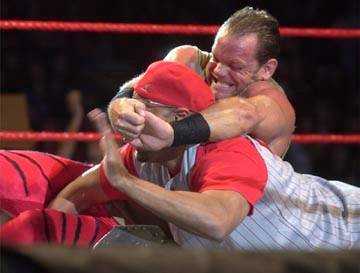
R.I.P. Chris Benoit: WWE Wrestler And Family Found Dead Today In Atlanta

World Wrestling Entertainment (WWE) today made the announcement on their website that wrestler Chris Benoit, along with his wife Nancy, and their son Daniel were found dead today at their home in Atlanta, GA. Benoit was 40 years old.

No other details regarding the circumstances of this discovery have been released by WWE or by the Atlanta police. Just this past weekend, Benoit had been scheduled to wrestle for the vacant Extreme Championship Wrestling (ECW) World Championship against C.M. Punk at WWE's Vengeance pay per view show. Benoit abruptly pulled out of the scheduled match just days prior, to attend what was called a family emergency in Atlanta. The match took place with another wrestler, Johnny Nitro, substituting for Benoit. In the match, Nitro won the ECW title.

Although he lacked the big, musclebound look of fellow WWE stars like Hulk Hogan, and the flashy microphone skills of Ric Flair and The Rock, Benoit was a favorite of diehard wrestling fans because of his aggressive, no-nonsense style in the ring. This style earned him many nicknames over his twenty-year career, including "The Rabid Wolverine" and "The Canadian Crippler." His most famous wrestling moves were a textbook flying headbutt off of the top turnbuckle, and the "Crippler Crossface," a punishing submission move that more often than not would cause his opponents to tap out.
During his twenty-year career, Benoit enjoyed success in all of the "big three" wrestling promotions, WWE, ECW, and the now defunct World Championship Wrestling (WCW). He also wrestled in Japan, where he enjoyed success wearing a mask as the Pegasus Kid. His most noteworthy matches included an ECW match against Sabu which ended in a broken neck for his opponent.

Another notable bout was a falls count anywhere in the building match against Kevin Sullivan for WCW. In an ironic real life twist, Benoit ended up marrying Sullivan's wife Nancy, who was a valet manager working under the name Woman. Benoit also enjoyed considerable success in WCW as a member in one of the final incarnations of the legendary Four Horsemen, the faction of heel wrestlers headed up by Ric Flair and Arn Anderson.

Chris Benoit won numerous championships during his career -- including tag team gold in both ECW and WCW -- before finally winning his first world championship in WCW in a match against Sid Vicious. He was stripped of that title however, when he defected to WWE, along with fellow WCW wrestlers Dean Malenko, Perry Saturn, and the late Eddie Guerrero.

Once arriving in WWE, Benoit made an immediate impact with fans, and eventually finally won a world championship he could keep, by defeating both Shawn Micheals and HHH at Wrestlemania XX.

Tonight's edition of WWE's flagship show Monday Night Raw on the USA Network will be a three-hour tribute to Chris Benoit. Ironically, the show had been scheduled to revolve around the scripted angle of the presumed "death" of WWE chairman Vince McMahon. That plan has for the moment been scrapped, in order to pay tribute to Chris Benoit and his family.

Raw airs on the USA Network at 9:00 PM in most time zones. Chris Benoit will be missed by wrestling fans throughout the world. Our prayers go out to his family.