Sunday, April 18, 2010

1971's Johnny Winter And Live Gets A Sequel 40 Years Later

Music Review: Johnny Winter And - Live At The Fillmore East 10/3/70

Although Johnny Winter And — the band the Texas blues guitar legend briefly fronted with fellow guitarist/vocalist Rick Derringer — only made two records together, many regard this group as one of the highlights of Winter's career.

1971's Live Johnny Winter And album in particular has often been cited as a favorite among longtime Winter fans, as well as with classic rock aficionados in general — due mainly to the group's smoldering cover of the Stones' "Jumpin' Jack Flash."

Although the band itself was short-lived, Winter and Derringer continued to collaborate off and on for several years, most notably on Derringer's most famous tune, "Rock And Roll Hootchie Koo." Derringer also played in several of brother Edgar Winter's bands during the seventies.

As part of a series of newly unearthed live concerts from this period being issued by Collectors Choice Music (the series also features artists ranging from Hot Tuna and Poco to John Denver) comes Live At The Fillmore East 10/3/70, a previously unheard live performance from none other than Johnny Winter And.

Although many of the tracks featured here like "Good Morning Little School Girl," "Its My Own Fault" and "Mean Town Blues" can already be heard on 1971's previously released Live Johnny Winter And, this new album is still noteworthy for a couple of reasons.

For one, it features a ferocious version of Derringer's "Rock And Roll Hootchie Koo" that spotlights some rather dazzling guitar interplay between Winter and Derringer.

If you close your eyes for a minute, you can actually hear the seeds of the sort of dual-guitar interplay that launched a million southern-rock bands later on in the seventies. The chemistry between guitarists Winter and Derringer is undeniable, and a good argument could be made based on this recording that Winter never again found a foil quite like Derringer — at least within the context of a blues-rock band.

But speaking of the blues, this is still the area where Winter himself most shines as a guitarist. Nowhere is this more evident than on the 22-minute "Its My Own Fault." Listening to this track today, in retrospect, it's clear that the blues was where Winter's true musical heart lied even way back then. It's not at all surprising that's the direction he eventually embarked upon as a full-time career choice following a brief flirtation with arena rock in the mid-seventies. Winter's playing on this track is quite simply stunning, and once again features some more fine interplay with Derringer.

But since this was the seventies, a Johnny Winter And concert was also expected to rock. Which they do most convincingly here on Dylan's "Highway 61 Revisited," the well-chosen rock and roll cover which occupies the "Jumpin' Jack Flash" spot on this set.

For those reasons, Live at The Fillmore East 10/3/70 makes a fine companion to the last live Johnny Winter And album from 40 some-odd years ago. Consider it a nice, if somewhat belated, gift from that old friend you've been meaning to visit again for awhile now.

Saturday, April 17, 2010

The Definitive History Of Pink Floyd Fans Have Waited For

Book Review: Echoes: The Complete History Of Pink Floyd by Glenn Povey


Glenn Povey's Echoes: The Complete History Of Pink Floyd comes exactly as advertised. It is not only a detailed, complete historical account on the meteoric rise of the band that practically invented both the space-rock and prog-rock genres — but also the pictorial souvenir book fans have long been salivating for.

Povey, a long-time, die-hard Pink Floyd fan and historian, has compiled the sort of lavish coffee-table book guaranteed to satisfy the hunger of these very same long suffering fans.

Lavishly illustrated with hundreds of never before seen photographs, Echoes is further augmented with the most exhaustively researched discography of the bands recordings ever assembled. Everything from pre-Pink Floyd efforts, to original band recordings, to solo albums and individual members appearances on various projects, is lovingly assembled with the sort of care that can only be the product of a true fans devotion. If nothing else, Echoes is definitely a labor of love.


Where it gets really interesting though, is when Povey delves into the setlists of nearly every live performance Pink Floyd has ever done.

Having seen the band myself a few times back during their seventies heyday, I found it particularly interesting to go back and read through their setlists in Seattle and Portland during the Wish You Were Here and Animals tours, as well as when I saw them play Dark Side Of The Moon in its entirety, many months before the album was actually released. For the most part, the setlists for these shows were exactly as I remembered them.

But the real treat here is the graphics, which include not only hundreds of rare photos, but also all kinds of things like ticket stubs, concert posters and the like spanning the bands entire history. Thumbing through these alone makes Echoes a treasure trove of memorabilia both for long-time fans, as well as for those too young to have been around to witness the phenomenon first hand.

As for Povey's narrative, the author hits all the usual points from Syd Barrett's tragic, pre-mature drug induced flameout, through the glory years of the seventies, to the bitter split and resultant legal battles between primary members Roger Waters and David Gilmour during the eighties and nineties.

To his credit, author Glenn Povey maintains a largely neutral stance throughout, although the portrait of Roger Waters (and particularly the way he treated band members like Richard Wright) is often less than flattering. What hardcore fans will find far more interesting is Povey's detailed accounting of Pink Floyd's early concert history billed under names like the Tin Cup, as well as pre-Floyd bands like Jokers Wild.

The author's bonafides speak for themselves. Povey is the founder of the respected Pink Floyd fanzine Brain Damage, as well as a contributor to publications like Mojo and Record Collector. Povey is also the author of a previous Pink Floyd book, In The Flesh: The Complete Performance History.

As both historical document and pictorial record, Echoes: The Complete History Of Pink Floyd more than lives up to its advance billing. This is the definitive account Pink Floyd fans have long waited for.

Sunday, April 11, 2010

Tina Fey Launches The Sarah Palin Network On SNL


Freakin' Hilarious....
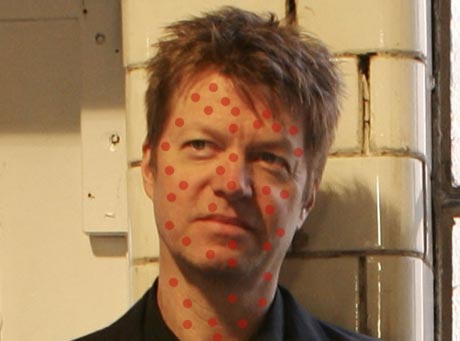
Nels Cline Makes Beautiful Whack Jazz  Noise On Initiate

Music Review: The Nels Cline Singers - Initiate


As anyone who has ever witnessed him perform with Wilco in concert will surely testify, Nels Cline is an absolute monster guitarist. What Cline adds to Jeff Tweedy's songs — particularly in a live setting — is in many ways the missing piece of the puzzle that finally completed this already formidable band.

But within Wilco, Cline is merely the guitarist — albeit a really great one — who is adding the window dressing to Tweedy's songs. What Cline does outside of Wilco, however, is another matter entirely.

To hear the guy playing on Initiate, Cline's new double-disc set with the Nels Cline Singers, you'd never think in a million years this was even the same guy. Musically, the two groups couldn't be further apart. In fact, some of the stuff on these two discs is so "out there," you'd be forgiven for questioning whether Cline and Wilco even exist in the same universe.

The Nels Cline Singers — Cline on guitar, bassist Devin Hoff and drummer Scott Amendola; none of whom actually sing, by the way — are for lack of a better term an often very noisy trio of experimental, avant-jazz musicians playing some of the most distorted, whacked-out music you've ever heard. I think I've finally figured out what "whack-jazz" actually is. Thanks, Nels.

But you have to have a certain predisposition to this sort of thing in order to "get it." For those who do, though, the music found on Initiate will astonish you to the point of thinking this may be the greatest thing you've ever heard. For those who don't, it'll probably make little sense at all. There really just isn't a lot of middle ground here.

On Initiate, the Nels Cline Singers don't so much perform traditional songs as they do stretch their boundaries by turning them into soundscapes. Usually beginning with a simple idea or a series of notes, the three musicians expand these sounds into a myriad of different directions ranging from traditional jazz to quiet ambiance to all-out cacophonous noise. It is when they engage in the latter on this album that I found myself most mesmerized.
Which is probably why I keep coming back to disc two of this set, which is a live recording from Cafe Du Nord in San Francisco. Kicking things off with "Forge," a seven-minute wall of sound that builds from a drum-and-bass-driven assault into an all-out frenzy of distortion and feedback courtesy of Cline, things don't let up a bit from there.

By the time of the third track, "Raze" — which is another fabulous eight-minutes of glorious, metallic noise — Cline takes it to a whole other level with high-pitched harmonic arpeggios that build to a powerful, throbbing crescendo of heavy metal, acid jazz...well, something or another.

Things quiet down some for a cover of Carla Bley's "And Now The Queen" and take a turn towards the Funkadelicious for Joe Zawinul's "Boggie Woggie Waltz." The amps get turned back up to eleven for "Thurston County," Cline's tribute to Sonic Youth's Thurston Moore. Anyway, that's just the live disc.
For the studio disc, Cline and company hop right back on the funk train for "Floored," with bassist Devin Hoff in particular getting a nice workout on a track somewhat reminiscent of fusion-era Miles Davis. As for Cline, the guitarist is once again in full screech mode here, moving from those crazy harmonic arpeggios to grating metal played at blinding speed.

On "Divining," Cline turns acoustic, providing lovely accompaniment to an ethereal, wordless vocal. Never one to stay quiet for too long, though, Cline gradually picks up steam as the song progresses, moving from a borderline flamenco flavor into slightly more dissonant sounds by its end. As noisy as much of Initiate is (particularly on the live disc) the guitar and the vocal here blend together beautifully.

"You Noticed" follows this nicely with the sort of quiet, more-refined sounding interlude for small trio that wouldn't be out of place on an old seventies ECM jazz recording. On "Grow Closer," Cline moves with ease from raga-esque guitar scaling into a nice little bit of bass plucking from Hoff that summons up some of the spirit of the late, great Jaco Pastorius.

On "King Queen," the Cline Singers are joined by organist David Witham for a bit of prog-psychedelia by way of Santana. The busy percussive vibe here is contagious, and Cline turns in one of his best solos of the entire set. Here, the eerie psychedelic organ seems to bring out the best in him. It's a direction I wouldn't mind seeing him explore more often. For me, this track alone is worth the price tag of the collection.
The Nels Cline Singers aren't for everybody, and fans of Cline's work with Wilco should be particularly forewarned this is music that exists in another universe entirely. But for those who "get it," Initiate may just possibly be the best slice of dissonant avant-new age whack-jazz noise metal you'll ever hear. Particularly on that live side.

Saturday, April 10, 2010

Iggy, Ziggy And The Raw Power Of The Stooges


It's been quite a year for one James Osterberg, better known to the world as Iggy Pop. By virtue of their induction into the Rock And Roll Hall Of Fame this year, The Stooges have actually gone legit.

I mean, who woulda' thunk it?

They never sold all that many records for one thing. And unlike many of their seventies punk-rock contemporaries — the Sex Pistols and the Ramones come most immediately to mind — they still don't.

Yet, you see their influence everywhere these days. And by that, I don't just mean in all of the punk rock bands from Nirvana on down who went on to make millions once punk finally arrived commercially in the nineties.

No, it actually goes much further and deeper than that. You see it everyday in television commercials using Iggy's songs like "Lust For Life" to hawk products and to stuff the pockets of the sort of corporate executives that I'm quite sure Iggy never gave two squats about (and outside of making a few well-earned bucks himself, probably still doesn't, for that matter).
A few weeks ago, The Stooges song "Search And Destroy" was even used on an episode of Lost for Pete's sake! Lord knows the MC5 should ever be so lucky.

But ya' know what? I say good for Iggy, but even more than that — good for the long-suffering Stooges. They deserve it, dammit.

See, here's the thing. For all of the mythical status the Stooges have attained in the decades since the original 1973 release of Raw Power, what they did was actually not that revolutionary at all. And therein lies the beauty of it all.

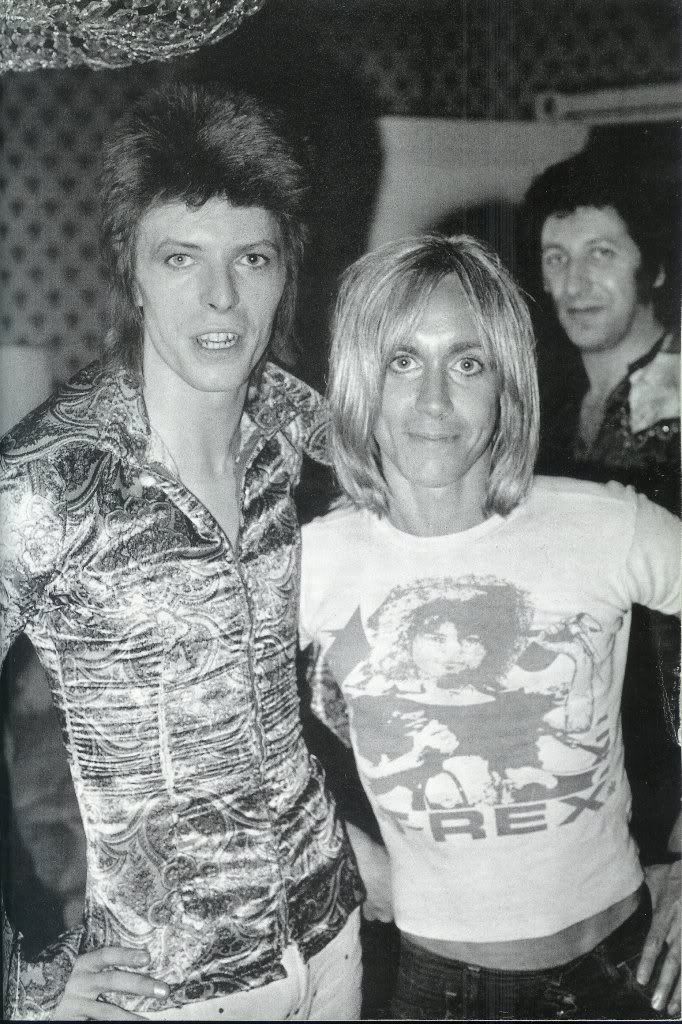
Long before Iggy and the Stooges ever had the good fortune to hook up with then emerging seventies glam-rock star David Bowie, they were kicking out primal, stripped-down rock and roll on albums like Fun House.

At a time when rock music had begun to take itself perhaps far too seriously with twenty-minute guitar solos, concept albums and what not, Iggy and the Stooges — along with bands like their aforementioned Detroit based compatriots, the MC5 — stood apart from the rest as a band who brought things back down to their rawest, must guttural level.
What got the Stooges all the attention though wasn't their music at all. The fact is, the Stooges didn't even play their instruments all that well. The draw, rather, was the freak show that was Iggy Pop. As a performer, I'm quite sure (even to this day) that Iggy often had absolutely no idea what he was doing. But as pure rock theatre goes, Iggy was as out of bounds and as out of control as it got.

Here you had a guy who was known to plunge himself head first into a crowd before there ever even was such a thing as stage diving. Reports of Iggy smearing peanut butter all over his body, and even cutting himself up with glass were also fairly commonplace.

For those brave or reckless enough to take the plunge, what you got at a Stooges concert back then was equal parts primal rock and roll stripped to its barest essentials, performance theatre, and a sense of genuine danger.

It's no accident that the Doors famously asked Iggy, their Elektra Records label mate, to become their new lead singer after Jim Morrison died. It is likewise no accident that David Bowie was so drawn to Iggy like a moth to a flame. With Raw Power, all Bowie really did was put some androgynous lipstick on a sixties punk-rock pig.

The thing is, shit like this has rarely before or since ever sounded so good. It may have happened completely by accident. But the fact remains that it is no small wonder that the Stooges had such a profound influence on all those guys playing in garages back in the seventies, like Nirvana who would later change the very direction of rock and roll.

I mean, what else was a poor boy who wanted to sing in a rock and roll band supposed to do? Buy a mellotron or hire a string section?

But to be perfectly honest, I have to admit that I was a late bloomer to the whole Iggy thing. I signed on long after the Stooges had flamed out, and back when Iggy was touring as a solo act behind the Bowie-produced album, The Idiot. In fact, the only reason I even went to a show in '76 at the Paramount in Seattle was because Bowie was playing keyboards in the band.
But not ten minutes into that performance, I completely forgot Bowie was even there. Iggy in the late seventies was as riveting a performer as I had ever witnessed up to that moment. There was a definite trainwreck vibe to the whole thing. But the bottom line was that it was absolutely impossible to take your eyes off of Iggy for even a second. From that moment on I was hooked.

A few years later in the early eighties, I witnessed Iggy make history during a Seattle concert at the Showbox by inciting what you could only call a riot. At this show, Iggy invited the entire audience up onstage, who then proceeded to knock the entire P.A. system off the stage. In retrospect, it's amazing no one was hurt or even killed, and the stunt resulted in Iggy being banned from performing in Seattle for many years thereafter.

Talk about performance art.

Up until tonight, I hadn't listened to Raw Power straight through in something like twenty years. To be honest, the main draw for me of Legacy's new remastered deluxe edition was the restoration of the much ballyhooed "Bowie mix" of the original tapes using modern digital technology.

And ya' know what? I just don't hear that much difference.
Yes, it sounds a little clearer, and less muddy. But the "remastered" recording still falls out in exactly the same places I remember it as a kid, only to blast your speakers out just a few scant seconds later.

But you know what? That's perfectly fine with me. Raw Power, if nothing else, represents a snapshot in time when rock needed a swift kick in the balls and the Stooges were exactly the band to deliver it. For that reason alone, their induction this year into the Rock Hall was a complete no-brainer. Some things are just not meant to be screwed with — and all hype aside, the studio guys here really haven't done so all that much.

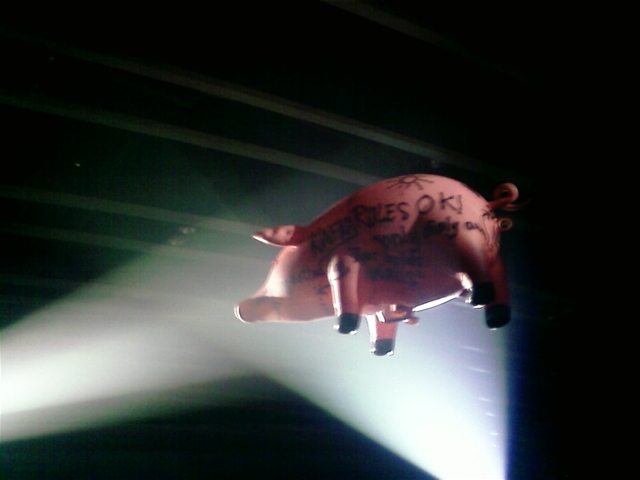
Which is exactly how it should be. Bowie's original good intentions aside, lipstick just doesn't look that good on a pig. Gimme Danger. Gimme Dirt.
What does make the new version stand out, however, are the extras.

On the two-disc version arriving in stores next Tuesday, the bonus disc features a great live performance from Atlanta (they're calling it "Georgia Peaches") in 1973.

While nowhere near as incendiary as the now hard-to-find Metallic K.O. recording from the same period (no one is chucking bottles at the stage for one thing), this disc captures a lot of the same raw energy, both on songs from Raw Power and such rare nuggets as "(I've Got My) Cock In My Pocket."

On the deluxe box which arrives on April 27th, you also get an additional disc of rare outtakes from the Raw Power sessions, as well as a 30-minute DVD on the making of Raw Power.

While the DVD doesn't really provide much other than the same sort of commentary from future fans like Chrissie Hynde, and the usual studio types sitting around a mixing board that you'd expect to find on one of those VH1 "Making of" documentaries, the included live footage from a Stooges reunion show last year in Brazil is three shades of awesome. James Williamson in particular kicks some major ass on that, and hearing a Stooges show where the band is actually playing pretty tight is a rare treat indeed (as with age comes experience).

So yes, this kicks some ass and it's nice to see these guys finally getting their due all these years later. After all, what good is putting lipstick on a pig if not to finally get kissed, right?

Next year, hopefully, the Rock Hall will make the big move to mascara. Can you say Alice Cooper?

Friday, April 9, 2010

Jeff Beck: The Guitar Mechanic Returns To Active Duty With A Stunner

Music Review: Jeff Beck - Emotion & Commotion


From a purely promotional standpoint, Jeff Beck's first studio album in seven years couldn't have had a better setup.

Emotion & Commotion comes on the heels of a series of high-profile live appearances with fellow guitar great and ex-Yardbird Eric Clapton, and last fall's star-studded 25th Anniversary concerts for the Rock & Roll Hall Of Fame.

It also follows last year's Performing This Week... Live At Ronnie Scott's — an amazing live concert document captured during Beck's residency at the venerable jazz and blues club. Backed by his great band including drummer Vinnie Colaiuta, keyboardist Jason Rebello, and bass prodigy Tal Wilkenfeld, Jeff Beck tore the house down at this show, particularly during a stunning version of the Beatles' classic "A Day In The Life."

You'd almost think the guy was mounting a comeback or something — except that Jeff Beck has never really been away. Although he is known nearly as much for the long gaps between his recordings as he is for being one of the two or three best guitarists on the planet, when Jeff Beck drops a new album people just tend to take notice.
Beck's albums don't just serve as reminders that he is one of the best in the world at what he does though. They also tend to reset the bar just that much higher for the rest of the pack. Perhaps because of their infrequency, albums like Blow By Blow or even the more recent Ronnie Scott's set have often been characterized by their brief, explosive bursts of stunning, and for my money anyway, quite unmatched guitar goodness.

Beck's solos just have this way of cutting through air like so many shards of shattering glass. The best part about them though, is the way they always leave you salivating for more.

The first thing you notice about the new Emotion & Commotion is that these same type of short, staccato blasts are somewhat less prevalent. But when they do come, they deliver exactly the same dizzying effect of literally knocking you on your tush, only to pick yourself up off the ground to ask, "thank you sir, may I have another?"

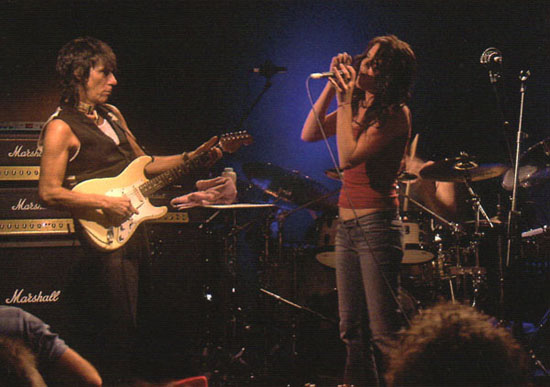
On "There's No Other Me" — one of the two tracks here featuring the sultry, soulful vocals of Joss Stone — Beck's guitar takes off into the stratosphere as Stone's superb vocal builds from a haunting cry to a howling, agonized crescendo.
Beck is nothing if not a master of economy here, despite all of the pyro. He accomplishes more with a Strat and a whammy bar in a few seconds, than many guitarists have over the course of their entire careers. For their part, the rhythm section of Colaiuta and especially the always amazing Wilkenfeld provide a bottom so deep it's almost spooky.

Earlier on in the album, Beck takes a page out of the Jimi Hendrix playbook for the "Voodoo Child"-like, wah-wah intro of "Hammerhead," before venturing off into more familiar jazz-rock fusion territory and another round of guitar fireworks. Here again, the solos are kept short and sweet — but will leave your jaw dropping to the floor no less.

On the more sublime sounding "Never Alone," and the Pat Metheny-like "Serene," Beck eschews the flash in favor of building a mood. Here again, his student Wilkenfeld compliments him perfectly on the bass on both tracks. Vocalist Imelda May likewise turns in an understated, but gorgeous-sounding performance on "Lilac Wine," which Beck matches with some equally lovely-sounding guitar flourishes.

In her other appearance on this album, Joss Stone goes from purring like a cat to roaring like a beast on the slowly building "I Put A Spell On You". Meanwhile, Beck lets his guitar simmer in the pot alongside her for the most part, before hitting a full boil near the end.
When Beck is not doing time with Joss Stone and company here, he is backed by a full orchestra on more classical-oriented material like "Elegy For Dunkirk" (with vocalist Olivia Safe), "Nessun Dorma" and even a curious, if ultimately plaintive and satisfying "Somewhere Over The Rainbow."

In that respect, Emotion & Commotion is almost like two albums in one. Although the orchestral interludes tend to be brief, they also represent an interesting and even promising new direction for Jeff Beck — who even at this late stage of the game appears to be continuing to elevate his game as a constantly evolving artist and musician.
But don't take my word for it. The album comes out next Tuesday. In the meantime you can have a listen for yourself. The guitar mechanic has returned to active duty with a stunner.

Friday, April 2, 2010

Stax Southern Fried Sixties Soul Is Just As Finger Lickin' Good Today

Music Review: Various Artists - Stax Number Ones


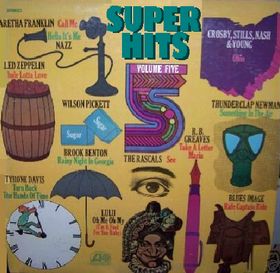
When I was growing up in the sixties, Atlantic Records used to have this really cool series of albums called Super Hits, where they would compile about twelve of their biggest-selling singles onto a single LP.

Since the Atlantic/Atco roster was one of the strongest in music at the time, this made these samplers can't-beat propositions. There usually wasn't a single clunker in the bunch. The album sleeves, which featured quasi-psychedelic cartoons with individual illustrations of every track, also pulled off the nifty trick of putting many of the top rock, psychedelic, and soul acts side-by-side in a single package.

So where on the one hand you might have Cream, Vanilla Fudge, and Buffalo Springfield; on the other you'd get Aretha Franklin, Wilson Pickett, and Sam And Dave. Balancing both sides out, there was also usually a track in there by the Rascals, who were Atlantic's golden boys of blue-eyed soul at the time.
The reason I bring all this up — aside from the fact that I really miss those compilations (which are long since out-of-print) — is the many similarities with them I found on Stax Number Ones, the newly issued collection of Stax Records tracks from Concord Music Group.

I'm not one hundred percent sure what the relationship between the original Memphis-based Stax Records and Ahmet Ertegun's much bigger Atlantic label was in the sixties. What is clear is that the bread and butter of each was southern-fried soul and R&B, and to that end many of the same artists and even the same tracks from those old Atlantic Super Hits collections show up on Stax Number Ones as well.

Specifically, Otis Redding's "Sitting On The Dock Of The Bay" and Sam & Dave's monster hits "Soul Man" and "Hold On I'm Comin'" are cornerstones of both the Atlantic and Stax compilations, and as such are also textbook examples of the two different sides of sixties soul. Where Redding's ballad was an early forerunner to the smoother soul of latter-day Quiet Storm formats, Sam & Dave's twin slices of sixties funk are both party classics that endure to this day.

Sam & Dave's "Soul Man" was of course one of many hits penned by Stax house songwriters Issac Hayes and David Porter. Hayes' own signature hit "(Theme From) Shaft" — also included on Stax Number Ones — is of course the song that kicked off a thousand such blaxploitation film themes from "Superfly" on down. Hayes' classic also features one of the most instantly identifiable wah-wah guitar riffs ever.

From those great classics forward, the hits just keep on comin' on Stax Number Ones. Booker T & The MG's "Green Onions" may best be remembered for its signature organ riff, but Steve Cropper's guitar breaks sound as crisp now as they did then.
The gospel side of the Stax sound is represented by the Staple Singers' "I'll Take You There," while Johnnie Taylor's "Who's Makin" Love" and Rufus Thomas' "Do The Push And Pull (Part 1)" are reminders of the simpler days when all a great song had to do to be sexy was offer a hint of carnal delight rather than paint a complete picture. Ah, those were the days...

As stylistically diverse a collection as Stax Number Ones is, what holds it all together is the distinctive Stax Records brand of Memphis Soul. A bit rougher around the edges than its closest sixties competitor at Motown, Stax Recordings were best characterized by their signature southern-fried sound. With great songs like these together on a single package, this Stax O'Wax Trax sounds just as finger lickin' good today.