Saturday, November 17, 2007

Stop Worrying! Help! Is Here!

DVD Review: The Beatles Help! (Standard Edition)

"Stop Worrying! Help Is On The Way!"

That line, or catch phrase if you will -- from one of two trailers (both included here as extras) for the American release of the Beatles' 1965 film Help! -- is just one of the many great things about it that I had completely forgotten about, when I sat down to watch this great film tonight for the first time in at least a decade or two.

For me, the Beatles second movie Help! represents a unique snapshot in time. And as I watched it tonight on the newly restored version they finally made available on DVD, the memories came flooding back.

Thank God, that whatever hurdles which kept this release from the public for so many years have finally been cleared. For me, Help! holds personal significance.


At the risk of sounding like a total music nerd -- but of course, you already knew that -- the Beatles, for better or worse, changed my life.

If there are moments in your life you forever remember -- things like 9/11 or when Kennedy was shot -- for me, the first of these moments was seeing the Beatles on the Ed Sullivan show when I was a seven year old boy. Even at that young age, I knew in my heart, that what I was witnessing was something that would alter history -- a fact which has since certainly proven true, and then some.

But as that same seven year old boy who sat transfixed in front of my parents television set on that night in 1964, there is absolutely no doubt that what I saw forever altered the course of my own life.
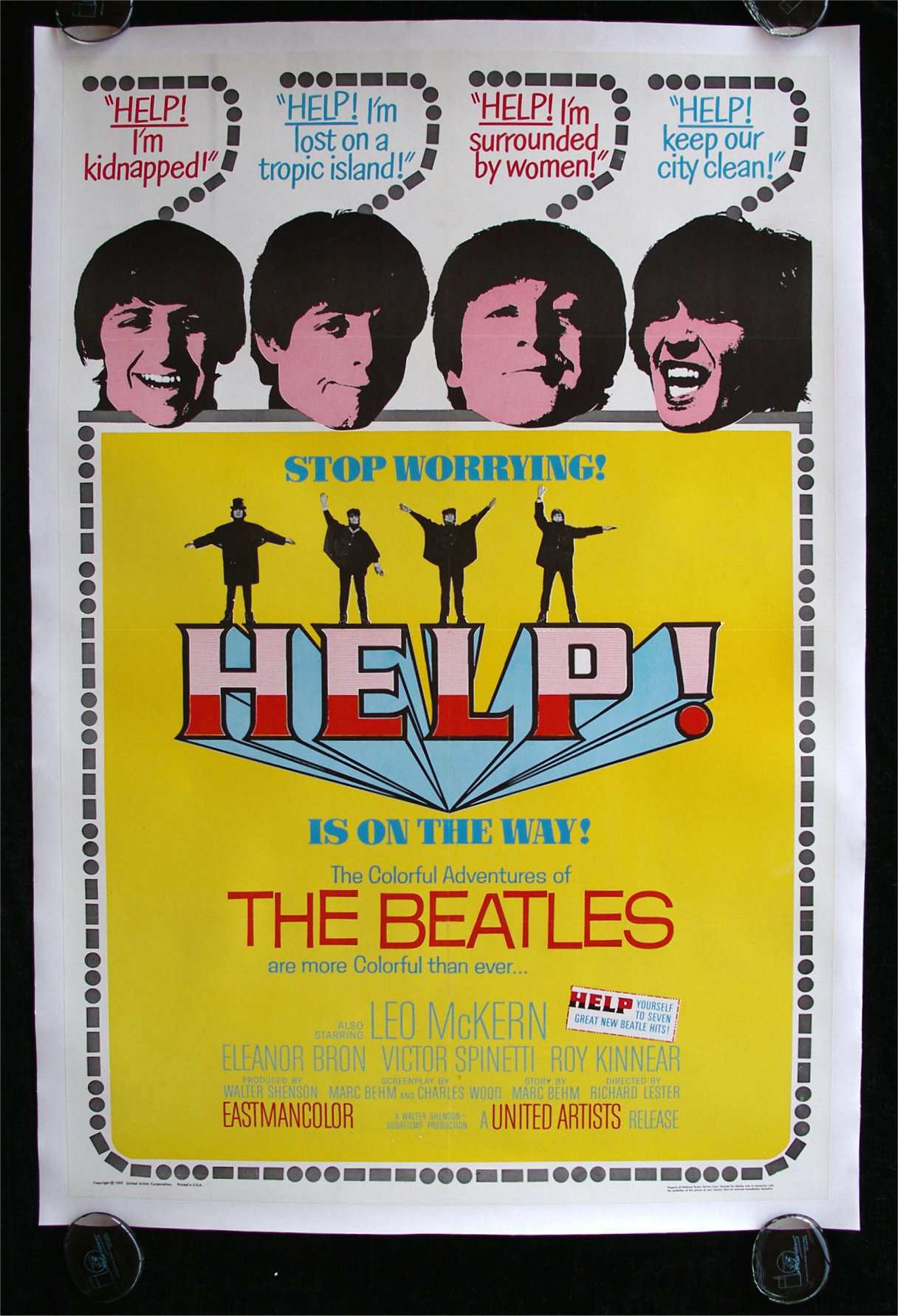
What I can also say, is that the first movie I saw in a theatre that I remember having a deep -- and as profound as it gets at that age -- effect on me was Help!. I had also seen the first Beatles movie A Hard Days Night in the theatre the year prior. My grandma -- who was as ultra-cool as grandmas get -- had taken me. But outside of the music, I didn't really get the movie. At seven, I was probably too young.

Help! on the other hand, held me glued to my seat, with its mix of great Beatles tunes, and way cool plot which (at the far more mature age of eight), reminded me of the great secret agent shows like The Man From U.N.C.L.E. I liked to watch on TV. Even some of the non-Beatles music on the soundtrack had that sort of secret agent thing about it. By the time I saw my first James Bond movie as a pre-teen, I was finally able to fully connect those dots.

Anyway, after I saw Help!, when the rest of my boyhood chums wanted to play "Army" or something, all I wanted to do was play Help!.

Which involved running around on the grass in my parents' yard like we we're being chased by a religious cult and a mad scientist, and then going down into my parents basement and bashing away at my toy drum set. In retrospect, I guess I can see why I wasn't able to drum up much interest amongst my boyhood chums.

So let's get the quibbles out of the way first about this new DVD release.

Unlike some of my fellow Blogcritics, I have to say for starters, that I am perfectly satisfied with the standard release. The main thing that seperates it from the much pricier deluxe version -- outside of things like a bigger and nicer box, a bigger book, a poster, and director Richard Lester's original annotated script -- is that the deluxe version comes in the original 1:75 aspect ratio.

Personally, I'm completely satisfied with the 1:33 (fullscreen) ratio offered here. And like I said, watching this DVD tonight, the memories came flooding back. What also comes from the benefit of a few decades of life experience, is the realization of just how smart a movie Help! really was.

There are the obvious things of course. Like the way this movie, made in 1965, pretty much wrote the original book for the way MTV styled videos would be made two decades later. There are also the less obvious references you pick up on in the actual dialog when you see Help! today.

There are all kinds of weird little things you pick up on watching Help! today. Like the references to things like the Freemasons in the original script (and who would have ever pegged the then still ever innocent moptops as conspiracy theorists?)

But I would have never made the obvious connection for example, to the scene where the recording engineer asks "who is buzzing?" in one scene. The culprit in the movie is of course the cultists chainsawing a hole under Ringo's drum kit -- but the inside joke becomes more obvious today given what we know now about the Beatles fondness for pot at the time.

I also really like the extras on the standard release. The booklet is modest, but really, really informative. It goes into detail for example about how they arrived on the final title of Help!, after rejecting Ringo's suggestion of "Eight Arms To Hold You" -- effectively blowing my ace-in-the-hole on rock trivia night at my local bar. I also like the way that the book explains how and why the exclamation point was added to the eventual title of Help!.

Seeing the original trailers for the film (one of which I referenced above) is also really cool. Likewise, I found the present-day interviews with everyone from director Richard Lester, to actors like Victor Spinetti and Eleanor Bron (one of my earliest childhood fantasies as the ultra sexy cult babe Ahme in the film) to be highly informative.

And then there is of course the music.

As a kid, when I bought the soundtrack for Help!, I was always used to skip past the orchestral score, just to get to the Beatles tunes. I never got the point of all that orchestra music back then. But it actually makes sense now. In addition to the James Bond sort of feel of those songs, you also hear how they were incorporating things like sitar into the mix -- no doubt due to the George Harrison influence.

And to this day, "The Night Before," which is only available on this soundtrack, remains one of my favorite Beatle songs.


So stop worrying. Help! is on the way.

Correction. Help! is here.

Tuesday, November 13, 2007

Blogcritics At Blogworld: We Came, We Saw, We Drank

Last week, I attended the 1st Annual Blogworld conference in Las Vegas, as part of a team of editors and writers from Blogcritics, the online magazine where I have been a writer for going on three years now, and where I currently serve as assistant music editor.

Blogcritics is read by about two million people every month, and has played a very big role (along with this blog) in revitalizing my writing (which I had basically put on a shelf somewhere to gather dust for about ten years, for reasons I'm not sure I'll ever completely understand).

All I know is that the past 2 1/2 years, I've written nearly 200 articles for BC and owe them a debt of gratitude for basically re-energizing my writing muse. Right now, I feel I'm doing some of the best work I've ever done, and over the past year or so my work for BC has been recognized in one way or another by everyone from ABC News to Howard Stern.

They have provided me the best forum for getting my work out there of my entire career as a writer, and as I already said I am extremely thankful to them for that. Besides that, they are also -- besides being some of the most intelligent folks I've ever met, some of the nicest as well.

Some of those folks are seen in the picture above, taken at our booth at the conference, including (L to R) executive editor Lisa McKay (whose husband Jim also took the pictures you see here), Gordon "El Bicho" Miller, Josh Lasser, Phillip Winn (back to camera), Matt "Suss" Sussman, Dave Nalle, our publisher Eric Olsen, and Anna Creech.

So as you can imagine, I was very excited about meeting the Blogcritics crew, and they did not disapoint. We had a blast in Vegas, and actually got a lot of work done as well -- that is, when we weren't out drinking until all hours of the morning anyway.

For most of the trip, the hardcore party crew basically boiled down to myself, Bicho, Phillip (who I also roomed with), and surprisingly (to me anyway) our culture editor Diana Hartman, who despite the "proper" image I had of her (online perceptions can be quite deceiving) more than held her own during one night out which began at the Hard Rock and ended up at 3 AM at an IHOP on the Strip.

Phillip, Bicho, and myself are pictured on a critics panel here that was attended by pretty much no one (a panel on ethics across the hall held at the same time was SRO I later heard). I'm in the middle between Phillip and Bicho, and the gentlemen on the end's name unfortunately escapes me. Speaking of that panel, we did have a very good discussion about the whole "critic" thing, although I fear I may have bored the others somewhat with my continuous references to Springsteen.

What can I say?

On the final night though, our publisher Eric Olsen and his lovely wife Dawn also got into the party act. Besides being every bit as fun (and funny) as her Glosslip columns would indicate, Dawn is also one hell of a dancer! Eric for his part is the master schmoozer, and was absolutely the right guy to have representing us with all the bigwigs at the conference.

As for the Blogcritics booth, we had a great location in the center of the convention hall, and seemed to be a lot busier during the event, then the big boys at Yahoo located directly across from us. I was also told by many we had the best swag at the event -- with our free books including one by "fake Steve Jobs," and the 2007 edition of Best Music Writing being particularly big hits. Blogcritics had great presesnse at Blogworld.

It was also nice getting to hang with my fellow music editor Connie Phillips at the event (we are pictured together here). Connie's kind of like the female equivalent of a teddy bear -- just a total sweetheart.
But she is also sharp as a tack and was all about business at Blogworld. We did a lot of tag teaming on the conference floor at the booth talking to folks about Blogcritics, including one gal who had a common link with me from my past -- Public Enemy's "Media Assassin" Harry Allen.
So over all, it was a very gratifying trip for me on a personal level, and I have to believe it was a very successful one for Blogcritics as well.

Sunday, November 11, 2007

The Rockologist: Welcome To The Hotel...Edgewater

It is a matter of record that the life of the touring rock star has two different sides to it. There are on the one hand the bright lights of the stage, the glitz and the glamour, the radio interviews, and the certain rush of thousands of adoring fans.
And then there is -- well, life on the road. It is also no secret that part of that life on the road -- and often, a significantly big part -- is spent trapped inside a series of interchangable hotel rooms.
Although it is probably not as true now as it was then, there was a time -- particularly during the seventies -- that bored rock stars confined to their hotel rooms before the big show, became particularly creative at finding ways to amuse themselves within these four walled prisons. For most, trashing their rooms was simply one of the required rites of passage for rock stardom. While for others -- like the Who's Keith Moon -- such activity was elevated to something of a high art.
It's one thing to toss a lamp out the window of a downtown high rise. It's quite another to drive a Rolls Royce into the hotel swimming pool.
But while such behaviour has earned several bands the distinction of being permanently banned from some of the nation's major hotel chains, a few brave innkeepers once actually embraced the concept. I mean, what's the cost of a few trashed rooms compared to the marketing possibilities of branding your inn as a destination point for touring rock stars?
During the seventies, the best known of these "rock-friendly" hotels was undoubtedly Los Angeles' Hyatt on the Sunset Strip. The Hyatt's history with touring rock bands is practically a primer itself in touring rock and roll hedonism, rife as it is with its countless tales of rock and roll nights of debauchery. The last time I checked, Little Richard even still maintained a permanent room there.
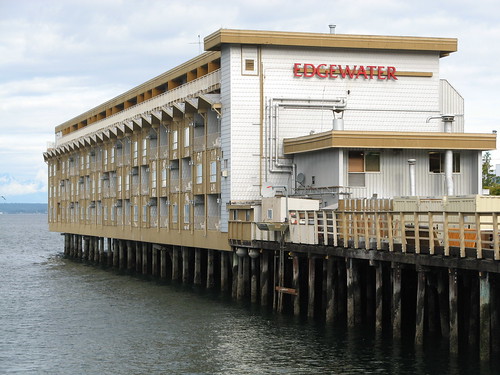
Although it is not nearly as famous -- at least not these days -- as the infamous "Riot Hyatt," Seattle's waterfront Edgewater Inn was also a required stay for touring rock bands back in the sixties and seventies. I haven't been down to the Edgewater in years. But the last time I was, the gift shop in the lobby was still decorated with pictures of its most famous rock and roll guests. The Beatles have stayed there, as have the Stones.
And the lure of the Edgewater back then, over the more posh five star hotels in Seattle?
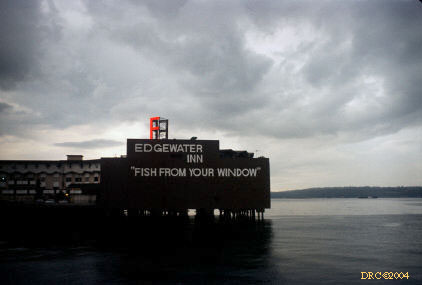
It's painted right on the side of the building: "Fish Out Your Window."

Probably the most famous rock story to come out of the Edgewater's history involves Led Zeppelin, a mudshark caught on one such window fishing adventure, and a hapless groupie who wound up with said mudshark stuck between her -- well, I'll let you the connect the dots there. This is, after all, still a family publication. Frank Zappa also immortalized the Edgewater in his song "The Mudshark," from the album Mothers Live At Fillmore East.
The Edgewater was also the best, and the easiest, place to meet visiting rock stars in the seventies. Like Cameron Crowe in the movie Almost Famous, I was an aspiring teenaged rock journalist back then, and I would regularly stake the place out with my buddies both before and after concerts, hoping to catch a glimpse of visiting rock royalty.
Surprisingly, I got lucky a lot more often than I didn't. From the age of sixteen up until about college, I actually ended up partying with a lot of rock stars as a result of such stakeouts. Later in life, when I finally fulfilled my boyhood dream of becoming a rock writer myself, I think that those early experiences actually helped ease my nerves when interviewing famous musicians.

As for the experiences themselves?
They are both numerous and quite memorable. Like the time I took southern rockers Wet Willie out to Seattle's waterfront restaurant Ivar's for some good old Seattle Fish And Chips. Or the time I took the Hendrix inspired guitarist Frank Marino from Mahogany Rush out to see Seattle's own best Hendrix tribute act Randy Hansen. When I took Marino backstage to meet Hansen (who was a friend of mine back then), he actually asked Randy to join his band.
I was in my early twenties then. But the best memories I have of partying with the rock stars at the Edgewater remain those that I experienced as a teenaged fan.
For example, there was the night I partied with Uriah Heep, after meeting drummer Lee Kerslake in the lobby of the Edgewater earlier in the day. Over the course of that evening, I threw martial arts stars into the door with vocalist David Byron, tossed a lamp out the window into the water below, and was sent to the front desk for salt to keep the mudshark Kerslake had caught alive in the bathtub (don't ask).
At sixteen years old, I also drank in the bar with the band. I had my first Harvey Wallbanger that night.

Which brings up another cool thing about hanging out with bands at the Edgewater back then. With my own long hair and standard issue platform shoes, I was able to blend right in with the band at the hotel bar. I drank in that damn bar with everyone from the lowly Heep to Rod Stewart and the Faces (on a tour where Ron Wood already knew he was leaving the band to join the Stones). I was never once asked for ID.
Of course not all visiting rock stars preferred the bar. When Brownsville "Smokin' In The Boys Room" Station played Seattle opening for ZZ Top, we piled them into our station wagon to go buy six packs of Rainier Beer (Cub Koda and the boys wanted a local brew) in Seattle's Chinatown. Our underaged beer retailer of choice back then was a place called the Wah Mee Club, which a few years later would gain notoriety as the site of a massacre involving Chinese gangs and gambling.
As God is my witness, I am not making this shit up.
So as me and my friends by this time had became somewhat regular fixtures at the Edgewater both before and after rock shows, we also got to know some of the local groupies. They had names like Anita Bandita and Stars N' Stripes (so named for her patriotic taste in under-garments).
When the then red-hot T. Rex visited Seattle, these groupies literally had every floor staked out hoping to bed hearthrob Marc Bolan. I think I actually pissed a few of them off when Bolan granted me alone entrance to his room to conduct one of my first actual interviews. This was not set up through any publicist, but rather came as a result of me simply pitching the tour manager in the Edgewater lobby earlier that day.
The interview was later published by my high school newspaper.
So I'm not sure how many rock stars still stay at the Edgewater these days. Although I'm pretty sure that "Fish Out Your Window" sign is still there on the side of the building, they've really renovated the place. My best guess is that visiting rock stars these days more favor places like the Four Seasons. And if any still stay at the Edgewater, I'm equally sure the hotel security is a lot tighter now.
But I'll tell you what. When the final history of Seattle as a rock and roll town is written, the Edgewater's place is every bit as assured as those of Kurt Cobain and Jimi Hendrix.

Sunday, November 4, 2007

The Best Music Writing of 2007: And Not A Single Blogcritic In Sight

Book Review: - Best Music Writing 2007 Edited by Daphne Carr (Series Editor) and Robert Christgau (Guest Editor)

When my copy of the latest installment in Da Capo's Best Music Writing arrived in my mailbox earlier this week, I couldn't wait to read it. But upon opening the book to the table of contents, the first thing that I noticed was that there were no Blogcritics represented.

Which drew a reaction of "What?"...

Surely, one of Mark Saleski's ever insightful Friday Morning Listens, like his recent one on Kiss Alive, had to qualify as being among the year's best music writing, I thought to myself.

Or perhaps one of Josh Hathaway's gushing setlist reports from the Springsteen tour.

No? Well, how about Pico's amazingly detailed look at Miles Davis' On The Corner box set then? Or even -- if I may be ever so humble -- one of my own Rockologist columns, such as my recent Open Letter to Neil Young?
Then as I began to read the introduction to the book, written by guest editor Robert "The Dean Of Rock Critics" Christgau, it all became clear to me. The first thing which leapt out at me was Christgau's dismissal of internet journalism, which, in his own words he regards as "a trackless waste of hastily composed one-upsmanship."

Okay.

Then, as I read further, I noticed something else that has actually bothered me for a very long time. And that is the simple question of why guys like myself, Saleski, Hathaway, Pico, and the rest can't make a decent living doing something we enjoy doing so much -- and would like to think we are fairly good at? The answer to that question also comes in Christgau's introduction to this collection of the best music essays of 2007.

Out of the hundreds of submissions for this book, and the fifty or so that finally made the final cut, a grand total of ten of the articles represented here come from the internet. And out of those, only three received any sort of monetary compensation for their efforts.

So I guess that clears that matter up, and thank you very much for clarifying that point Mr. Christgau. To use your own letter grade system of rating albums, you get an A for that.

So as to the book itself, Best Music Writing 2007 is not so much a book for fans of music as it is for fans of music journalism. In this collection of music essays from 2007, the editors take what purports to be the best of the lot, and presents them as they originally appeared in print, or (apparently occasionally) online.
The sources here range from pieces written for places as obvious as Rolling Stone, to websites like Pitchfork Media (which Christgau again pulls no punches in hiding his disdain for). The writers range from seasoned -- and a few not-so seasoned -- journalists, to musicians like David Byrne and Richard Hell (who writes a particularly passionate piece on the closing of New York punk club CBGBs).

As a music journalist, and as someone who really enjoys reading music journalism, I really enjoyed several of the essays in this book. Among those that really stood out for me were Ann Powers piece on how the Latino immigration movement has adopted Neil Diamond's song "America" as their own; Jonathan Lethem's excellent "Being James Brown,"; and a piece by Michaelangelo Matos on the Supremes' song "Love Child" that I understand actually became a multimedia presentation at a rock critics symposium here in Seattle, held earlier this year and sponsored by the Experience Music Project.

So as I said, this book is not so much necessarily for music fans as it is for fans of those who write about the subject. And on that note, it comes highly recommended from this music journalist.

As for any of us Blogcritics making the cut?

I got two words for ya' Christgau:

Next year.

Believe that!

Saturday, November 3, 2007

Music Review: Van Morrison - Still On Top: The Greatest Hits

Van Morrison is one of those performers who rock critic types like me — you know, the folks who worship at the altar of people like Dylan and Springsteen — are supposed to be in absolute awe of.

But I've gotta tell ya' the truth here:
I've never completely got Van.

What I can tell you is this. I absolutely recognize the fact that Van Morrison has an undeniably soulful voice that, at its best, can take you to some pretty amazing places — at least as far as going into the furthest reaches of the subconscious goes. Van is definitely that rare breed of vocalist whose emotive quality can transport you to places far, far away.
Understood.
But for me, his catalog — vast as it is — has always been sort of spotty.
For the record, I've seen Van Morrison twice in concert.
The first time was in the late seventies. I think he was on his comeback tour for the album Wavelength, and I have to be honest here, the lure for me, like many on this night, wasn't Van so much as it was his opening act. Rockpile fronted by Nick Lowe and Dave Edmunds, were shit hot at the time.
Still, I was curious to see the guy who had built such a great reputation for amazing concerts. Now, I've gotta be fair here. The billing of Van Morrison, the great Irish soul singer, with Rockpile, the pub rockers with the New Wave pedigree of Elvis Costello producer Lowe probably wasn't the best idea. Especially given the fact that music was particularly polarized along genre lines at the time.

Still, when Van did his entire set with his back to the audience — he was probably pissed because the Rockpile fans who comprised about one third of the audience had left — he didn't exactly win me over.
The next time I saw Van was a few years later, at the urging of a fellow writer — and Van Morrison disciple — at Seattle's music magazine The Rocket. Greg (God Bless him), pretty much dragged me out to see him. This time around Van was touring behind the great album Inarticulate Speech Of The Heart. And unlike the debacle with Rockplie, the show was absolutely amazing — especially when Van went into his trance like reading of that album's standout, spoken word poetry track, "Rave On, John Donne."

This was an awesome performance. And by now I was almost ready to be 100% on board on the Van Morrison train.
Which brings me back to that original problem.
Van has this amazingly huge, but very spotty catalog. There have been several songs and albums along the way which have genuinely moved me, but the thing that has always been lacking is consistency. If only there were a single album I could own with all of the songs I have loved from Van over the years — "Gloria" and "Here Comes The Night" from his years with Them; stuff like "Moondance," "Wavelength," "Crazy Love," "Rave On John Donne," and more recently, "Stranded" from his solo output.
Still On Top is almost that album. Almost.
As it stands, this is probably the most complete overview of the best of Van Morrison one could ask for. Many of those favorite songs of mine I mentioned are indeed here. You've got everything from those early hits with Them, all the way through his best solo stuff from albums like Moondance, Tupelo Honey, and Wavelength, to his more recent output like the aforementioned "Stranded."
Still, what's missing is somewhat frustrating. I can understand the exclusion of my own personal faves like "Rave On, John Donne." The Inarticlate Speech record, while a personal fave, wasn't exactly a big commercial hit. But what about the amazing Astral Weeks?
Now, that is what I would call a major hole.
Still, for casual Van fans like me — the ones who sit patiently on the fence waiting to be converted — Still On Top will do nicely for now.
At least until that comprehensive retrospective boxed set comes along.

Thursday, October 25, 2007

Concert Review: Neil Young At WAMU Theatre, Seattle, WA 10/23/07

So what seperated the 2007, $170. a ticket version of Neil Young in concert, from previous models seen and heard at considerably more reasonable prices in past years?


In a lot of ways, not much truth be told. Although -- unlike past Neil Young shows where you usually get either an exclusively acoustic show, or the more hard rocking, cranked to eleven model (usually with Crazy Horse) -- with this past Tuesday's Seattle stop on the Chrome Dreams Continental tour, you did get the whole package in one shot. And you got quite a bit of it to boot, in a show that ran nearly three hours figuring in breaks and intermissions.

Another big difference with Neil this time around was the way the show ran like clockwork. Despite its length, it started and ended right on time, and the intermission times between sets -- at fifteen and twenty five minutes respectively -- were strictly adherred to, and kept as though handed down by law.
This actually made for some discomfort during the break between the acoustic and electric sets. The twenty five minute break alloted you barely enough time to stand in the single line bathroom, and you could pretty much forget about attempting to grab a frosty beverage (in keeping with the inflated ticket prices, a Bud Light at the WAMU cost $8.25 anyway).
So when the familiar strains of a particularly cranked sounding "The Loner" sounded the alarm to return to your seat, you were then made to wait in the lobby until the song ended. Which only created a mass of people trying to get to their seats by the time of the second electric tune, "Everybody Knows This Is Nowhere." A pretty pointless exercise all told, since this actually made the visibility for those already seated even worse in the flat-as-a board WAMU Theatre (there is no slope in the rows at the venue), as a throng of folks crowded the aisles in search of their seats.
With that said, the setlist at this show was nothing short of a dream come true for a hardcore Neil Young fan.

Heavy on rarities, and even some never before heard songs, I can honestly say that I never thought I would live to see such rarely played songs as "Ambulance Blues" from On The Beach performed live by Neil Young.
Yet there it was, as the very second performed tune of the evening in the acoustic portion of the show, sandwiched in between the opening "From Hank To Hendrix" and the never released "Sad Movies," (rumored to be intended for the likewise unreleased Homegrown album).
I've been to numerous Neil Young concerts where I have heard songs like "Rockin In The Free World" and "My, My, Hey, Hey" performed dozens of times (neither were here). But there was no denying the feeling that this was something special. Of course, since such typically played songs were not performed, you had the usual "rawk n' roll" types screaming out for them -- a fact that Neil seemed to take with uncharacteristically good humor. At one point, when one such fan yelled for "Like A Hurricane" (which was later played in the encore), Neil responded by asking "where's the seque?"
From Rust Never Sleeps to Greendale, Neil Young has also become known for the goofy ways he likes to decorate his stage, and this show was no exception. There was everything up there from a cigar store Indian, to an oddly lettered backdrop -- which didn't seem to make any sense at all until the end of the evening when it appeared to spell out "Pegi And Neil." During the electric portion of the evening, there was also a huge easel where each song was introduced by a different painting depicting the song title.

Speaking of the electric set, words simply cannot describe the way he tore into a twenty some odd minute, feedback drenched version of the song "No Hidden Path," from the new Chrome Dreams II. This was vintage, cranked up Neil playing in that trance-like state he gets himself into where he sways back and forth so hard you just hope he doesn't fall over and hurt himself.

Here is a very short clip of "No Hidden Path" I found on YouTube from the WAMU show:


I've read some other reviews of this show on the internet -- mostly linked over on Thrashers Wheat -- where it has been suggested that Neil looked old, or that he otherwise was "phoning it in." I don't know what show they were at, but from my 14th row vantage point Neil both looked and sounded great to me.
The only other thing that I really noticed as far as this show being any different from past shows, was that the crowd was nowhere near as mixed as I usually remember, and definitely tended to skew older. The mix seemed to be part professional computer geek types (I'm pretty sure I spotted Paul Allen seated a few rows from us), and what my concert pal for the evening referred to as "old grey ponytail special." It was the sort of mix (or rather, the lack thereof) that I would one hundred percent attribute to the higher ticket price.
The opening set, by Neil's wife Pegi, was pleasant enough, even if wasn't anything particularly special. The good news is that Pegi has a nice voice, a few decent songs, and in general managed to escape the curse of rock star wives trying to share the stage that has plagued music going back at least as far as Yoko Ono (and boy do I smell some trouble coming for what I just said).
Still, there was no escaping the fact that there was indeed a "special" sort of feel about this show.
Now if Neil would only consider sharing that "specialness" with some of his, shall we say, "lower rent" class of fans.
Setlist:
Acoustic:
1. From Hank To Hendrix
2. Ambulance Blues
3. Sad Movies
4. A Man Needs A Maid
5. No One Seems To Know
6. Harvest
7. After The Gold Rush
8. Mellow My Mind
9. Love Art Blues
10. Love Is A Rose
11. Heart Of Gold
Electric:
12. The Loner
13. Everybody Knows This Is Nowhere
14. Dirty Old Man
15. Spirit Road
16. Bad Fog Of Loneliness
17. Winterlong
18. Oh, Lonesome Me
19. The Believer
20. No Hidden Path
Encores:
21. Cinnamon Girl
22. Like A Hurricane

Tuesday, October 23, 2007

Two Songs Make Chrome Dreams II A Must-Have For Neil Young Guitar Opus Fans

Music Review: Neil Young - Chrome Dreams II

Although I consider myself a pretty major Neil Young fan, I will be the first to admit that there are large chunks of his catalog that are -- shall we say -- "spotty."
There are of course those Neil Young records which are unqualified masterpieces -- a category where I would squarely place Harvest, Harvest Moon, Rust Never Sleeps, and Freedom.

And for every one of those, at the other end of the spectrum you've got those records like Everybody's Rockin and Life that just kind of make you scratch your head and go "what was he thinking?"
But there are also those albums that I like to think of as Neil's "in-between" records. A few of these have been real surprises that have grown to be among my favorites over the years, such as the droning, depressing On The Beach and the grungey, Kurt Cobain-influenced Sleeps With Angels (whose Cobain tribute "Change Your Mind" is a song I'd rank among his best).

Neil also has made a handful of albums that have one or two standout tracks, with the rest consisting -- on the surface at least -- mainly of filler. American Stars And Bars struck me that way the first time that I heard it, with the brilliant "Like A Hurricane" standing way out from the rest of the pack on that record. Even so, over the years the rest of the album eventually really came to grow on me -- especially the fireside crackle of "Will To Love." The more recent Are You Passionate is another one of those, although nothing else on that album has stayed with me quite the same way the blazing guitar of "Comin' Home" did.

On an initial listen, Chrome Dreams II really feels like another one of those type of albums. Like those other "in-between" albums, lying at the center of Chrome Dreams II are two standout tracks. The sprawling, eighteen minute "Ordinary People," is one of those marathon Neil Young songs, that like others such as "Hurricane" or "Cortez The Killer" basically serves as a vehicle for him to go off on one of those trance-like guitar excursions he is so known for.

Unlike those songs however, the guitar work is less grungey sounding than recent electric Neil Young -- and definitely less so than on Living With War, last year's cranked to eleven anti-Bush rant for example. In places the guitar here actually harkens more back to the psychedelic sound of something like Everybody Knows This Is Nowhere and that album's own twin blasts of extended, electric Neil, "Cowgirl In The Sand" and "Down By The River." There are also some nice keyboards, and a horn section backing the track that takes you back to the bluesy sound of This Note's For You.

"Ordinary People," like many of the tracks here is also apparently one that has been around for awhile, which explains some of the dated sounding references to people like Lee Iacocca in the lyrics. Available in bootleg versions for years, the track is said to be part of an original Chrome Dreams CD that Neil nearly released in 1976.
As the story goes, he shelved the project after Joni Mitchell criticized it as being a little too "all over the place." Whether he chose to revisit this project now as a result of his ongoing trip through the vaults for the impending definitive series of Archives said to be finally about to see the light of day or not, the description fits here as well.
The other "big" track here is "No Hidden Path," which like "Ordinary People" is another lengthy electric guitar workout, which at eleven minutes is only slightly shorter. Here again, the big dark sounding guitar work is front and center, but Neil again seems more interested in revisiting the more psychedelic edges of his early work than the grunge of nineties-era Crazy Horse. For fans of the lengthy Neil Young guitar opus in the tradition of "Hurricane" and "Cortez," these two tracks alone make Chrome Dreams II a must-have.

Outside of those, Chrome Dreams II is an album that is as all over the place as its apparently thirty-year-old source material would seem to indicate. The rest of the album is a mixed bag to be sure. "Dirty Old Man" is one of those goofy-ass songs in the tradition of Ragged Glory's "Fuckin' Up" that Neil comes up with from time to time. This one is about a "Dirty Old Man" who likes to get hammered and fool around with the boss' wife. The track is actually a lot of fun, and harkens back to the lovingly, but sloppily executed rock sound that fans of Crazy Horse will love.

"Boxcar" starts out with the sort of banjo sound that would have been right at home on Prairie Wind, and maintains a lovely sort of country vibe, as it weaves a plaintive tale of a vagabond on a frieght train in the lyrics. Meanwhile, other tracks here seem to take on a more spiritual tone. The borderline gospel of "Shining Light" never makes it quite clear whether the "shining light" that Neil has found here comes in the form of carnal love or the divine. Either way, the song is one of the prettiest he has included on an album in awhile. "The Believer" is another song that seems to hint at spirituality, but is never overtly clear about it. The arrangement here is a quiet, simple, and understated one of piano, guitar, and drums.

For "Spirit Road" he once again straps on the electric guitar and mines more familiar terrain in the lyrics as well. "Spirit Road" finds him "headed out on the long highway in your mind" in search of the "spirit road you had to find" where "getting home to peace again" await the traveler at the road's end.

So on its surface, Chrome Dreams II is a mixed bag that feels like one of those notoriously "in-between" Neil Young albums I alluded to earlier. Some are calling it his best in years, although I'm not really sure I'm quite ready to go there yet. What I will say is that there is at least a little bit of every element here that has made Neil Young such an enduring artist over the years.

There's some nice quiet acoustic stuff, some of the grungier sound you'd more often associate with Crazy Horse, and even a few surprises in the form of a few gospel flavored tracks. And there are at least two lengthy electric guitar classics in the mode of "Like A Hurricane."

For right now, that's good enough for me.